Introduction
This guide explains how to play teen patti, the common rules and hand rankings used at most tables, and the sequence of actions in a typical hand. It covers the mechanics new players need to join a table: boot (ante), blind vs seen play, betting, pack (fold), sideshow, and show. Rules and exact names can vary by site or home game — where variations are common the text notes them.
What is Teen Patti?
Teen Patti (also called 3 Patti) is a three-card card game derived from traditional English three-card brag. The objective is to make the best three-card hand and win the pot of bets placed during a hand. Most online and home tables use a standard 52-card deck with no jokers.
How to play teen patti: step-by-step
1. Setup and boot (ante)
Before cards are dealt, all players (or the dealer) place an initial stake called the boot or ante into the pot. The boot creates a starting pot and gives players something to play for. The amount and who posts it can vary by table or platform.
2. Dealing
Each player receives three cards face down. The dealer position rotates in most games. After dealing, players decide whether to play blind (without looking at their cards) or to look at their cards and play seen. The terms and procedures for blind/seen play can differ by variant; this guide describes the common forms.
3. Betting rounds (chaal)
Betting continues clockwise, typically starting with the player to the dealer's left. On a player’s turn the usual options are:
- Check/call — match the current stake to stay in the hand.
- Raise — increase the stake; a raise must at least match the current bet and follow any local minimums for raises.
- Pack (fold) — fold and forfeit any claim on the pot.
Players who are blind sometimes have different minimums for calling or raising compared with seen players. Online tables and home rules vary, so check the table rules before playing.
4. Sideshow (optional)
A sideshow (also called a "side-show" or "compare") is a mechanic where a seen player can ask to privately compare cards with the previously seen player. If the other player accepts, the lower hand folds immediately and the winner stays in the hand. Not all games allow sideshows, and the ordering, eligibility, and acceptance rules vary by table.
5. Show and winning the pot
When only two players remain and one player requests a show, both reveal hands and the best hand wins the pot. A show may also occur if all other players fold. If more than two players want a show at once the house rules determine whether a multi-way show is allowed. The highest-ranked hand according to the table’s ranking list wins the pot.
Teen patti rules: common hand rankings
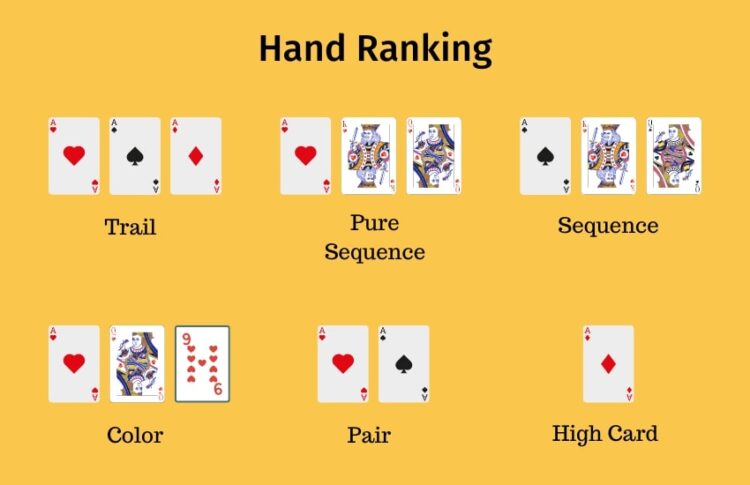
Hand naming and exact order can vary by table. The list below is the common ranking from highest to lowest at many tables. Read the table rules where you play to be sure.
- Trail (Trio / Three of a kind) — Three cards of the same rank. Example: A♠ A♥ A♦.
- Pure sequence (Straight flush) — Three consecutive cards of the same suit. Example: Q♣ J♣ 10♣.
- Sequence (Straight) — Three consecutive cards not all of the same suit. Example: 9♣ 8♦ 7♠. Note: A-2-3 is usually a valid low sequence; A-K-Q is the high sequence.
- Color (Flush) — Three cards of the same suit that are not in sequence. Example: K♦ 9♦ 4♦.
- Pair — Two cards of the same rank plus a third unrelated card. Example: J♠ J♦ 7♣.
- High card — If no one has any of the above, the highest single card wins. Example: A♣ 10♦ 6♠.
When two players have the same category (for example two pairs), the comparison follows standard card rules: compare the ranks of the primary combination, then kickers if necessary. Exact tie-breaking can depend on table rules.
Example round (sample hand played through to show)
This example walks through a four-player hand with common choices. It illustrates the sequence from boot through show.
- Players: Alice, Bhavesh, Charu, Deep.
- Boot: Each player places the boot into the pot (amount not shown; varies by table).
- Deal: Each player receives three cards face down.
- Choices after looking:
- Alice looks at her cards and decides to play seen.
- Bhavesh remains blind.
- Charu looks and plays seen.
- Deep remains blind.
- Betting: The first player to act (table-specific) places a bet. Players proceed clockwise. Bhavesh (blind) may call without looking; Alice and Charu (seen) can call/raise or ask for a sideshow with the previous seen player when rules allow.
- Sideshow: Charu requests a sideshow with Alice. If Alice accepts they compare privately and the lower hand folds. If Alice declines, the game continues with the next player.
- Fold: Suppose Deep folds (packs) during his turn and is out of the hand.
- Show: With two players remaining (Alice and Bhavesh), Bhavesh—who is blind—requests a show. The table checks whether a blind player can request a show at this point (rules vary). If a show proceeds both reveal hands and the higher-ranked hand wins the pot.
Note: The example avoids specifying numeric bets or minimum raise sizes because those vary by platform and house rules.
Variations to expect
- Some tables use different names for hands (trio vs trail) or change the exact ranking order.
- Sideshow availability, who may request it, and whether a blind player can call a show differ by site and home game.
- Many online platforms offer extra variants (fixed-limit, progressive jackpot modes, or side-bets). Read the specific variant rules before playing.
Beginner tips and common misunderstandings
- Read the table rules first. Betting minimums, who posts the boot, and sideshow rules commonly differ between rooms.
- Blind vs seen matters: seen players generally have more information and therefore may face higher minimums or different raising rules on some tables.
- Don’t assume local home rules apply online (and vice versa). Clarify show and sideshow mechanics before betting real money.
Related links
Learn more about the game listing and category on TeenPattiGames:
- 3 Patti — game page with basic information.
- Card Games — category page for other card games covered on the site.
Responsible play
Teen Patti involves betting and chance. Make sure you meet legal-age requirements where you play, understand the risks, and set limits you can afford. Do not chase losses.
FAQ
How many cards does each player get?
Each player is dealt three cards face down from a standard 52-card deck.
What does "boot" mean?
Boot is the initial stake placed into the pot to start a hand. The amount and who posts it depend on table rules.
What is the difference between blind and seen?
A blind player has not looked at their cards; a seen player has. Betting privileges, minimums, and available actions can differ for blind vs seen players depending on local rules.
Can a blind player be beaten by a seen player?
Yes. A blind player’s cards are compared in the same way as a seen player’s at showdown. Whether a blind player may request or accept a show at certain times is table-dependent.
Is sideshow always allowed?
No. Some tables allow an agreed private comparison between seen players; others do not. Confirm before playing.
Conclusion
This guide gives the practical sequence and terminology new players need to join a Teen Patti table: boot, dealing, blind vs seen, betting (call/raise/pack), sideshow, and show. Because some mechanics vary by platform and home rules, check the specific table rules where you play.