Teen Patti Hand Rankings Explained
Teen Patti hand rankings determine which three-card hand wins when players compare cards. The standard categories are easy to learn, but some tables use different rules for the order of particular sequences. For that reason, learn the categories first and always check the table rules for special cases.
1. Trail or Trio
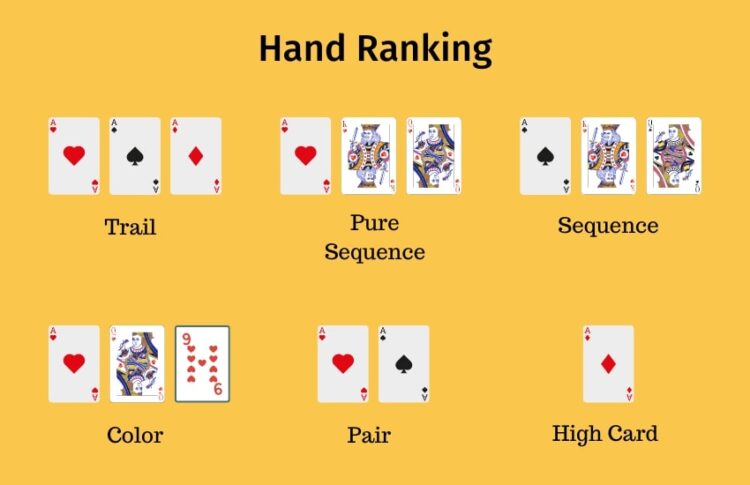
A trail, also called a trio or three of a kind, contains three cards of the same rank. Examples include A-A-A, K-K-K and 7-7-7. Under common Teen Patti rules, trail is the strongest hand category.
2. Pure Sequence
A pure sequence contains three consecutive cards of the same suit. For example, 9-10-J all in hearts forms a pure sequence. It combines consecutive ranks with a matching suit.
3. Sequence
A sequence contains three consecutive ranks but not all three cards are of the same suit. For example, 6 of hearts, 7 of clubs and 8 of spades form a sequence.
Rules concerning the highest and lowest ace-containing sequences can differ. Some tables treat A-2-3 differently from A-K-Q, so confirm the specific rule set before comparing those hands.
4. Color
A color contains three cards of the same suit that do not form a pure sequence. For example, 2-7-K all in diamonds is a color. When two color hands are compared, the ranks of the cards are normally used to break the tie according to the table rules.
5. Pair
A pair contains two cards of the same rank plus one different card. For example, Q-Q-5 is a pair of queens. When two players both have pairs, the higher pair normally wins; if the pairs are equal, the remaining card can be used as a tiebreaker.
6. High Card
If a hand is not a trail, pure sequence, sequence, color or pair, it is ranked by its high cards. For example, A-J-7 of mixed suits is a high-card hand. Comparisons normally proceed from the highest card downward until a difference is found.
Ranking Order at a Glance
- Trail / Trio
- Pure Sequence
- Sequence
- Color
- Pair
- High Card
Pure Sequence vs Sequence
The difference is the suit. Both hands use consecutive ranks, but all three cards in a pure sequence share the same suit. A regular sequence does not. This makes the pure sequence the stronger category under common rules.
Color vs Pair
A color ranks above a pair in common Teen Patti rules. This can surprise players familiar with other card games, so it is worth learning the Teen Patti ranking order rather than applying poker rankings.
Why Table Rules Still Matter
Teen Patti has many regional and commercial variations. Special hands, joker formats and alternative sequence rules can change how a particular game is settled. The ranking list above describes the common traditional categories, not every possible variant.
Frequently Asked Questions
Is a pure sequence higher than a trail?
No under common Teen Patti ranking rules. Trail or trio ranks above pure sequence.
Does color beat a pair?
Yes under the common ranking order, color ranks above pair.
Is A-2-3 always the highest sequence?
No. Ace-related sequence ordering is one of the rules that can vary, so check the rules for the specific table or app.